
The best development setup in 2026 is not on your laptop. It is a remote machine that appears when you need it, runs your toolchain in isolation, and vanishes when the job is done. That pattern — remote and ephemeral dev sandboxes — is how modern teams keep environments reproducible, keep credentials off local disks, and keep AI-generated code away from production networks.
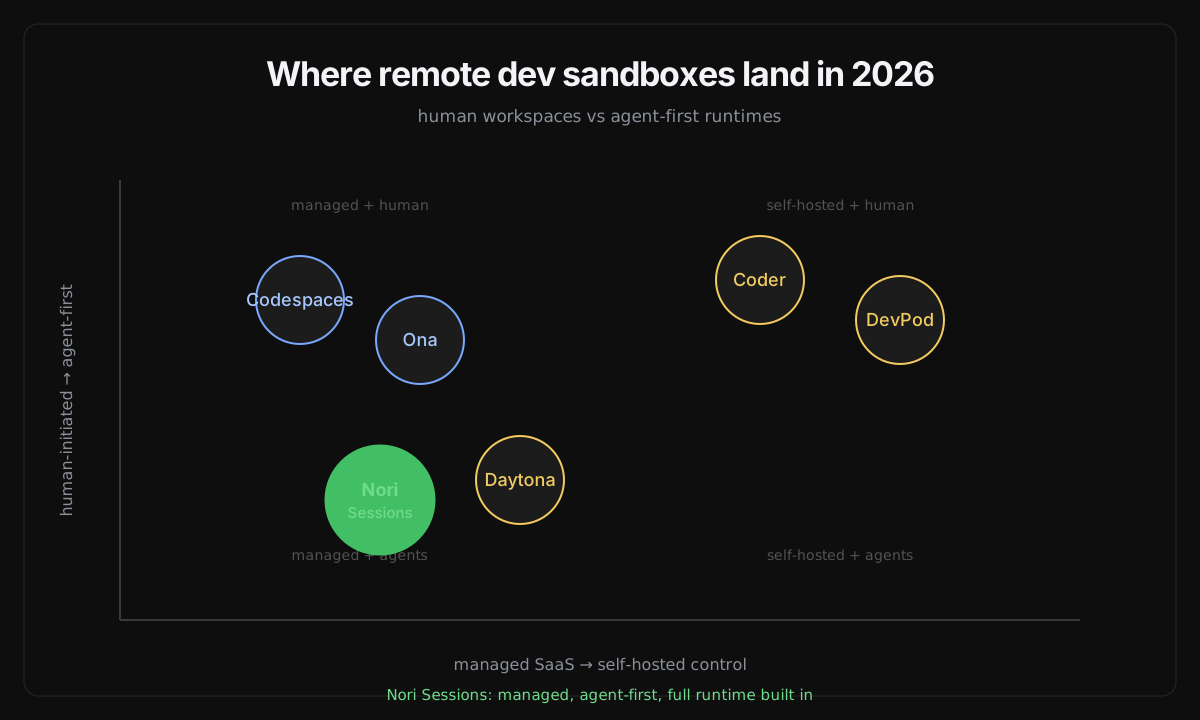
The category is crowded and converging fast. GitHub Codespaces made ephemeral cloud dev the default for millions of repos. Ona (formerly Gitpod) rebranded around autonomous agents. Daytona, Coder, and DevPod offer self-hosted control for teams that want their data in their VPC. Every option can spin up a machine. The question is what happens on that machine — especially when the worker is an agent, not a human clicking “Start workspace.”
The remote sandbox providers
GitHub Codespaces is the path of least resistance for GitHub teams: one-click environments from any repository, browser or desktop IDE, and billing tied to core-hours from $0.18/hour on a 2-core machine up to $2.88/hour on 32 cores (GitHub docs). Personal accounts include 120–180 core-hours per month. It is polished, deeply integrated, and priced for human developers opening environments from pull requests — not for fleets of agents running overnight.
Ona (formerly Gitpod) still provisions sandboxed, ephemeral remote environments — now framed as “mission control” for software engineering agents (InfoQ). Environments run up to 32 vCPUs and 128 GB RAM, integrate with GitHub and GitLab, and bill via Ona Compute Units: Core tier from $20/month with pooled credits, environment rates from $0.12/hour for 2 vCPUs (Ona pricing). The agent story is real — Ona reports agents co-authoring a majority of merged PRs internally — but OCU consumption varies by task, and unattended scheduling still flows through Ona’s platform rather than your chat tools.
Daytona ships as Apache 2.0 open source with a managed cloud option. It is devcontainer-spec compatible, supports warm starts under ten seconds, and has pushed hard into AI-agent sandboxes with sub-90ms creation times on its programmatic API (VibeReference, Daytona pricing). For teams that want self-hosted ephemeral environments and fast agent sandboxes, Daytona covers both — at the cost of running and securing the platform yourself.
Coder is the enterprise standard for self-hosted remote development: Terraform-provisioned workspaces on any cloud, VS Code and JetBrains support, RBAC and audit logging on Premium (Coder pricing). Community Edition is free open source; Premium is sold via enterprise quote with AI workspace provisioning and governance add-ons. Coder excels when a platform team needs maximum control over where code lives — regulated industries, air-gapped deploys, thousands of engineers. It is infrastructure you operate, not a button your agents press from Slack.
DevPod takes the opposite approach: a free, client-only tool with no server to install. Point it at Docker, Kubernetes, AWS, GCP, Azure, or SSH and it provisions devcontainer.json workspaces in any backend (OSSAlt). Startup runs 30–120 seconds. There is no built-in team layer, no agent mode, and no managed control plane — DevPod is a sharp knife for individuals and small teams who bring their own cloud bill.
How they compare
| Platform | Deployment | Pricing model | Agent triggers built in |
Chat-native control | Terminal + editor on demand |
|---|---|---|---|---|---|
| GitHub Codespaces | Managed (GitHub) | Per core-hour metered | ✗ | ✗ | ✓ |
| Ona | Managed (+ VPC option) | OCU credits from $20/mo | partial | ✗ | ✓ |
| Daytona | Self-hosted or cloud | OSS free; cloud metered | ✗ | ✗ | ✓ |
| Coder | Self-hosted | OSS free; Premium quote | partial | ✗ | ✓ |
| DevPod | Client + your cloud | Free client; infra varies | ✗ | ✗ | ✓ |
| Nori Sessions | Managed | Flat $50 / runtime / mo | ✓ | ✓ | ✓ |
Publicly reported capabilities and pricing as of July 2026. See sources below.
How to choose a remote dev sandbox
Six criteria cut through the marketing faster than a feature checklist:
- Who presses start. Human-initiated workspaces (Codespaces, DevPod) assume someone opens an environment from a PR or CLI. Agent-first teams need machines that boot from cron, webhooks, or chat — without a human in the loop.
- Where your code lives. Managed SaaS (Codespaces, Ona) gets you running in minutes. Self-hosted (Coder, Daytona, DevPod) keeps data in your VPC but demands a platform team (InfraGap).
- Pricing predictability. Core-hour and OCU metering is fair for bursty human usage. Agent fleets that run overnight need a budget line, not a surprise invoice.
- What ships preloaded. A bare VM still needs an agent harness, repo access, credential wiring, and org conventions loaded before any work happens.
- The notification path. When an unattended run finishes, results need to land where your team already works — not buried in a dashboard.
- The human escape hatch. Agents do most of the work; humans still need a real terminal and editor on the actual machine when something goes sideways.
Every provider in the table nails the bottom of the stack: an isolated machine that boots from a repo. The split is everything above that line.
A sandbox is not a runtime
Remote dev sandboxes solved the reproducibility problem. Spin up from devcontainer.json, get the same toolchain every time, tear down when done. That is table stakes in 2026.
What sandboxes do not solve is the agent workflow on top. Before an agent ships a pull request from an ephemeral machine, someone has to install the agent, connect GitHub and Slack, configure model routing, load org-specific instructions, build the scheduler for overnight runs, and wire notifications back to the team. Codespaces gives you the machine. Ona and Coder are adding agent layers. Daytona gives you a fast API. None of them ship the full stack — triggers, chat control, durable org context — as a single product you can hand to an engineering team on Monday morning.
Why Nori Sessions wins
Nori Sessions is a remote dev sandbox built for the agent-first era. Every session is an ephemeral cloud machine that arrives with the entire runtime already standing:
- Spin up from anywhere. Cron and webhook triggers launch sessions with no human attached. This very article was researched, written, and opened as a pull request by a scheduled Nori Session.
- Chat-native control. Drive sessions from Slack or Discord and get results back in the thread. Your team’s existing tools are the interface, not another dashboard.
- Durable org context. Skillsets load every fresh machine with your org’s instructions, memory, and tools, so agents show up already knowing how you work.
- Integrations wired in. GitHub, Slack, and the rest of your stack connect at the org level — not reconfigured on every ephemeral boot.
- A real workspace on demand. A full terminal and editor are one click away whenever a human wants to inspect or take over.
And instead of core-hour math, OCU credits, or a platform team to operate Coder — Nori Sessions is a flat $50 per runtime per month, with a Premium tier that adds hands-on org setup and dedicated support. Predictable enough to budget. Simple enough to explain in one sentence.
The bottom line
If you need a remote machine for a human developer, the field is mature: Codespaces for GitHub teams, Ona for multi-provider agent workflows, Coder or Daytona for self-hosted control, DevPod for a lightweight client. But if what you actually want is agents doing work in ephemeral cloud machines — on a schedule, from chat, with your context loaded — you do not want a sandbox API or a workspace provisioner. You want the finished runtime. That is Nori Sessions, and it is the layer this entire category is racing to assemble. We already ship it.
Spin up your first Nori Session and put your agents to work.
Frequently asked questions
What is a remote ephemeral dev sandbox?
A remote ephemeral dev sandbox is a short-lived cloud machine provisioned on demand from a repository or template, preloaded with dependencies, and torn down when the work finishes. GitHub Codespaces, Ona, Daytona, Coder, and DevPod all provide variations of this pattern — isolated environments that keep code off local laptops while remaining reproducible across the team.
How is a dev sandbox different from a cloud IDE?
A cloud IDE is primarily an editing surface in the browser. A dev sandbox is the compute layer underneath — the machine, toolchain, and integrations where builds, tests, and agents actually run. Many products bundle both, but the sandbox is what makes the environment ephemeral, isolated, and safe to spin up per task or per agent.
Which remote dev sandbox is best for GitHub-centric teams?
GitHub Codespaces is the default for teams already on GitHub: one-click environments from any repo, deep PR workflow integration, and metered pricing from $0.18 per hour on a 2-core machine. Ona also integrates with GitHub and GitLab and offers larger machine sizes up to 32 vCPUs, but bills via Ona Compute Units rather than straightforward core-hours.
Can remote dev sandboxes run coding agents unattended?
Most remote dev sandboxes are built for a human clicking “start environment.” Ona has added autonomous agents, and Coder Premium adds AI workspace provisioning — but scheduling, notifications, and chat-native control still require custom wiring on those platforms. Nori Sessions ships cron and webhook triggers built in, so agents launch, execute, and report back with no human attached.
How much do ephemeral dev environments cost?
Pricing varies widely: GitHub Codespaces charges $0.18–$2.88 per hour depending on core count, Ona Core starts at $20/month with pooled Ona Compute Units, Daytona cloud usage is pay-as-you-go from about $0.0504 per vCPU-hour, Coder Community is free open source with Premium sold via enterprise quote, and DevPod itself is free with infrastructure costs on your chosen cloud. Nori Sessions is a flat $50 per runtime per month.
Should I self-host or use a managed dev sandbox?
Self-hosted options like Coder, Daytona, and DevPod keep data in your VPC and suit regulated industries that can staff a platform team. Managed services like GitHub Codespaces and Ona trade control for speed — minutes to first environment instead of weeks of setup. Nori Sessions is managed and agent-first: you get ephemeral cloud machines without operating the control plane, plus built-in triggers and chat-native control from day one.
Sources
- GitHub Codespaces billing — GitHub Docs
- Gitpod Classic PAYG sunset — Ona
- Gitpod Rebrands to Ona — InfoQ
- Cloud Development Environments comparison — VibeReference
- Daytona pricing — Daytona
- Coder Plans & Feature Comparison — Coder
- Daytona vs DevPod vs Coder — OSSAlt
- CDE vs Alternatives — InfraGap
Related guides
- Top AI Coding Agent Runtimes & Sandboxes in 2026 — the isolation layer beneath every remote sandbox: Firecracker, gVisor, and the APIs that boot in milliseconds.
- Top Cloud-Based IDEs in 2026 — the editor surface your team uses once the sandbox is running.
- All guides — every comparison guide in one place.